


Most organizations have spent decades hiring deep specialists — people who know one thing very well and do it reliably. That model still has a place. But the most effective employees today tend to look different: they have genuine depth in one area and enough working knowledge across adjacent fields to actually collaborate with people outside their function. This is what people mean when they say “T-shaped skills,” and it’s worth taking seriously as a frame for how you build and evaluate your team.
McKinsey’s research on building workforce skills at scale found that T-shaped skill development is one of the highest-leverage investments organizations can make — directly tied to agility, resilience, and long-term growth.
What Are T-Shaped Skills?
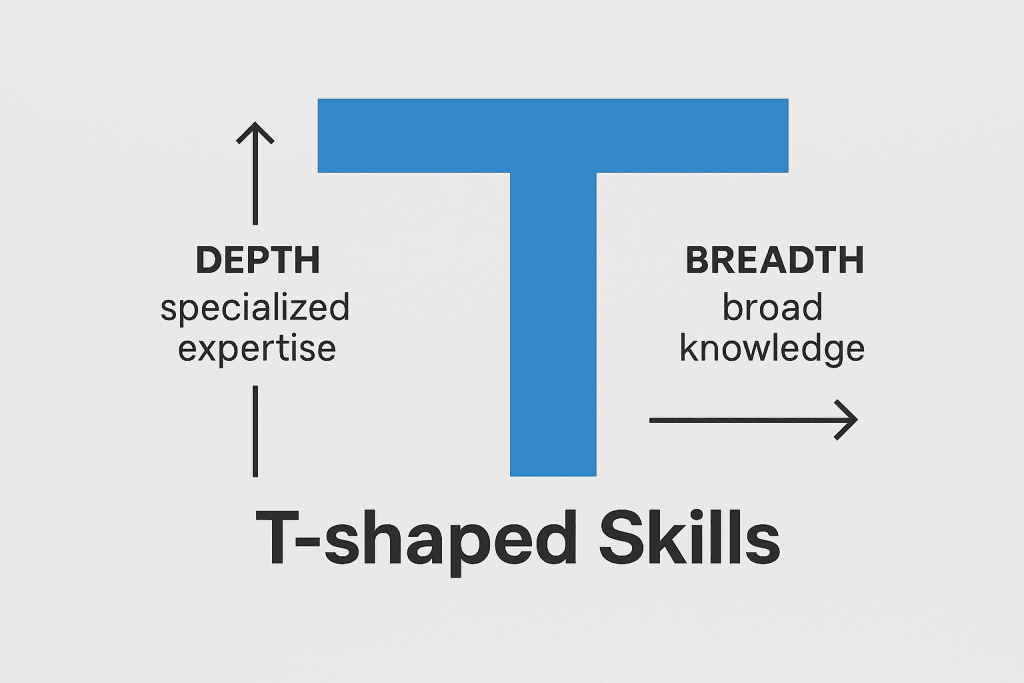
The letter T is a useful visual. The vertical bar is depth — specialized expertise, hard-won knowledge in a specific discipline. The horizontal bar is breadth — a working understanding of adjacent domains, enough to speak other people’s languages and follow conversations outside your specialty.
- The vertical bar of the “T” represents depth – specialized expertise, deep knowledge, and advanced capabilities in a specific domain or discipline.
- The horizontal bar represents breadth – a working knowledge across multiple adjacent disciplines, the ability to speak the language of different specialties, and the capacity to collaborate across domains.
Think of a software developer who understands UX principles and can hold a real conversation with a product manager about business tradeoffs. Or a marketer who knows enough about data to read an analytics report without needing a translator. The technical depth is what makes them valuable in their role. The breadth is what makes them useful to everyone around them.
Why T-Shaped Skills Matter in Modern Organizations
Breaking Down Silos
Organizations structured around rigid departmental boundaries often struggle with collaboration. T-shaped professionals act as natural bridges between specialties, speaking multiple “professional languages” and translating between domains. According to McKinsey, companies with effective cross-functional collaboration are 1.5x more likely to report higher organizational health scores.
Accelerating Innovation
Innovation rarely happens within the confines of a single discipline. T-shaped skills allow concepts from one domain to inspire breakthroughs in another. A study by Harvard Business Review found that teams with T-shaped members produced 18% more innovative solutions than those with purely specialized talent.
Adaptability Under Change
As market conditions and technologies shift, organizations need employees who can pivot without months of retraining. T-shaped professionals pick up adjacent skills faster because they already have context. Research from Deloitte shows that companies with adaptable workforces are 4.3x more likely to be market leaders.
Improving Team Dynamics
Teams built from T-shaped individuals tend to communicate better and show more empathy across roles — simply because people understand what their colleagues actually do. A Google study on team effectiveness found that groups with members who could understand different perspectives consistently outperformed those with more homogeneous skill sets.
T-Shaped Skills in Performance Management
Rethinking Evaluation Criteria
Traditional performance management tends to evaluate technical competence within a specific role. If you want T-shaped professionals, your evaluation frameworks need to catch up. They should reward both dimensions:
- Technical Excellence: Continued mastery in primary specialization
- Cross-Functional Impact: Contributions beyond formal job boundaries
- Knowledge Transfer: Ability to translate specialized knowledge for others
- Collaborative Outcomes: Results achieved through interdisciplinary work
Setting T-Shaped Development Goals
Performance conversations should explicitly address both bars of the T. Development plans might include:
- Deepening primary expertise through advanced training
- Shadowing colleagues in adjacent roles
- Cross-functional project participation
- Formal learning in complementary disciplines
- Mentoring relationships across departments
Measuring T-Shaped Progress
Tracking T-shaped development needs both quantitative and qualitative signals:
- Skill Assessments: Measuring depth in specialty and breadth across domains
- Contribution Analysis: Evaluating impact within and beyond formal role
- Peer Feedback: Gathering input from multiple disciplines
- Project Versatility: Ability to contribute to diverse initiatives
- Knowledge Application: Successfully applying concepts across contexts
Identifying T-Shaped Potential in Your Team
Not everyone displays T-shaped tendencies naturally. Watch for these signals:
Curiosity Beyond Boundaries
T-shaped candidates show genuine interest in areas outside their specialty. They ask real questions about other disciplines, not just polite ones.
Connective Thinking
Pay attention to employees who draw connections between unrelated concepts or apply ideas from one domain to solve problems in another.
Communication Versatility
T-shaped professionals adjust how they explain things based on who’s in the room. They can make their specialty accessible without dumbing it down.
Learning Agility
These are the team members who pick up new tools and frameworks quickly, especially when they’re voluntarily exploring areas outside their job description.
Collaborative Instinct
T-shaped individuals don’t just tolerate cross-functional work. They seek it out.
Developing T-Shaped Skills Through Performance Management
Create Cross-Training Opportunities
Formalize opportunities for employees to learn about adjacent disciplines:
- Rotation Programs: Structured exposure to different functions
- Shadowing Initiatives: Observation of related roles
- Cross-Functional Projects: Assignments requiring diverse expertise
- Learning Circles: Groups focused on knowledge sharing across departments
- Skill Exchanges: Peer-to-peer teaching of specialized knowledge
Recognize and Reward Breadth
If your recognition systems only reward depth, that’s what people will develop. Make breadth count:
- Acknowledge contributions outside formal job descriptions
- Celebrate knowledge transfer across boundaries
- Reward successful cross-functional collaboration
- Promote based on both depth and breadth
Provide Contextual Learning
Help employees see how their specialty connects to the broader organization:
- Share business context and strategic priorities
- Explain interdependencies between functions
- Demonstrate end-to-end processes that cross departments
- Invite participation in cross-functional decision-making
Build Psychological Safety
Developing T-shaped skills means letting people be beginners in new domains. That requires an environment where it’s safe to not know things yet:
- Normalize learning curves when exploring new areas
- Encourage questions across disciplinary boundaries
- Celebrate attempts to apply knowledge in new contexts
- Create space for cross-functional experimentation
Challenges in Developing T-Shaped Skills
Depth vs. Breadth Tension
The main challenge is balance. Without clear guidance, employees might:
- Neglect their core expertise in pursuit of breadth
- Resist expanding beyond their comfort zone
- Develop shallow knowledge that doesn’t translate to real value
Performance management should address this tension directly, helping employees find their optimal balance rather than leaving it to chance.
Organizational Barriers
Traditional structures can work against T-shaped development:
- Rigid job descriptions that penalize boundary-crossing
- Functional silos that limit exposure to other disciplines
- Recognition systems that reward only specialized contributions
- Managers who don’t see the value in versatility
Individual Resistance
Some employees will push back on T-shaped development, usually because of:
- Fear of diluting their expertise identity
- Comfort within established skill boundaries
- Concern about maintaining mastery in their primary domain
- Uncertainty about how to balance competing priorities
Implementing T-Shaped Performance Management: A Practical Framework
Step 1: Skill Mapping
Start by mapping where your organization actually stands:
- Identify core domains of expertise within your organization
- Define proficiency levels within each domain
- Determine valuable cross-domain knowledge
- Map current skill distribution across teams
- Identify gaps in both depth and breadth
Step 2: Define T-Shaped Success Profiles
Create clear pictures of what T-shaped excellence looks like at each level:
- Junior Level: Primary focus on depth with exposure to adjacent areas
- Mid-Level: Strong specialization with working knowledge in related domains
- Senior Level: Mastery in primary area with substantial capabilities across multiple functions
- Leadership: Deep expertise plus strategic understanding across the organization
Step 3: Integrate into Performance Management
Embed T-shaped development into your performance system:
- Update competency frameworks to include cross-functional skills
- Revise evaluation criteria to reward versatility
- Train managers to discuss both depth and breadth in reviews
- Create development planning tools that balance specialization and expansion
Step 4: Design Learning Pathways
Build structured paths for T-shaped development:
- Map logical skill adjacencies for different roles
- Develop learning resources for common cross-training needs
- Create mentorship programs that cross functional boundaries
- Design projects that require balanced T-shaped teams
Step 5: Measure and Adjust
Track whether your T-shaped initiative is working:
- Monitor changes in skill distribution through regular assessment
- Evaluate improvements in cross-functional collaboration
- Measure innovation outcomes from diverse teams
- Assess employee engagement with development opportunities
- Gather feedback on the T-shaped framework itself
The Future of T-Shaped Skills in Performance Management
As organizations become more complex, T-shaped talent becomes more valuable, not less. Forward-thinking performance management will evolve to:
- Dynamically balance depth and breadth based on organizational needs
- Use AI to identify optimal skill combinations for specific challenges
- Create personalized T-shaped development paths based on individual strengths
- Measure the network effect of T-shaped professionals across the organization
- Quantify the innovation premium from cross-functional capabilities
Multi-Dimensional Feedback
Traditional performance reviews often focus narrowly on role-specific skills. Evalio enables:
- Feedback from multiple functional perspectives
- Assessment of cross-boundary contributions
- Recognition of collaborative impact
- Evaluation of knowledge transfer effectiveness
T-Shaped Development Planning
Evalio’s development tools support balanced growth through:
- Personalized learning pathways that balance depth and breadth
- Progress tracking across multiple skill domains
- Resource recommendations for adjacent skill development
- Visibility into organizational skill needs
Project Team Optimization
Build more effective teams with Evalio’s team composition insights:
- Identify optimal skill mixes for specific projects
- Spot complementary T-shaped profiles
- Recognize collaboration opportunities across departments
- Track team performance based on skill distribution
Conclusion
T-shaped professionals bridge functional gaps, move ideas across teams, and adapt when priorities shift. That makes them genuinely difficult to replace.
Building T-shaped talent doesn’t happen by accident. It requires performance management systems that recognize both bars of the T — depth and breadth — and create real incentives to develop both. Organizations that get this right end up with teams that are faster, more creative, and more resillient than those built purely around specialization.
The first practical step is usually the same: stop evaluating people only on what they know within their job description, and start asking what they contribute to the people around them.